Recycled pallets
Already seasoned.
Still working.
A recycled pallet has survived handling that a new one has only been tested for. The weak boards have already failed and been replaced; what is left is dry, dimensionally stable hardwood at roughly a third of the price of new.
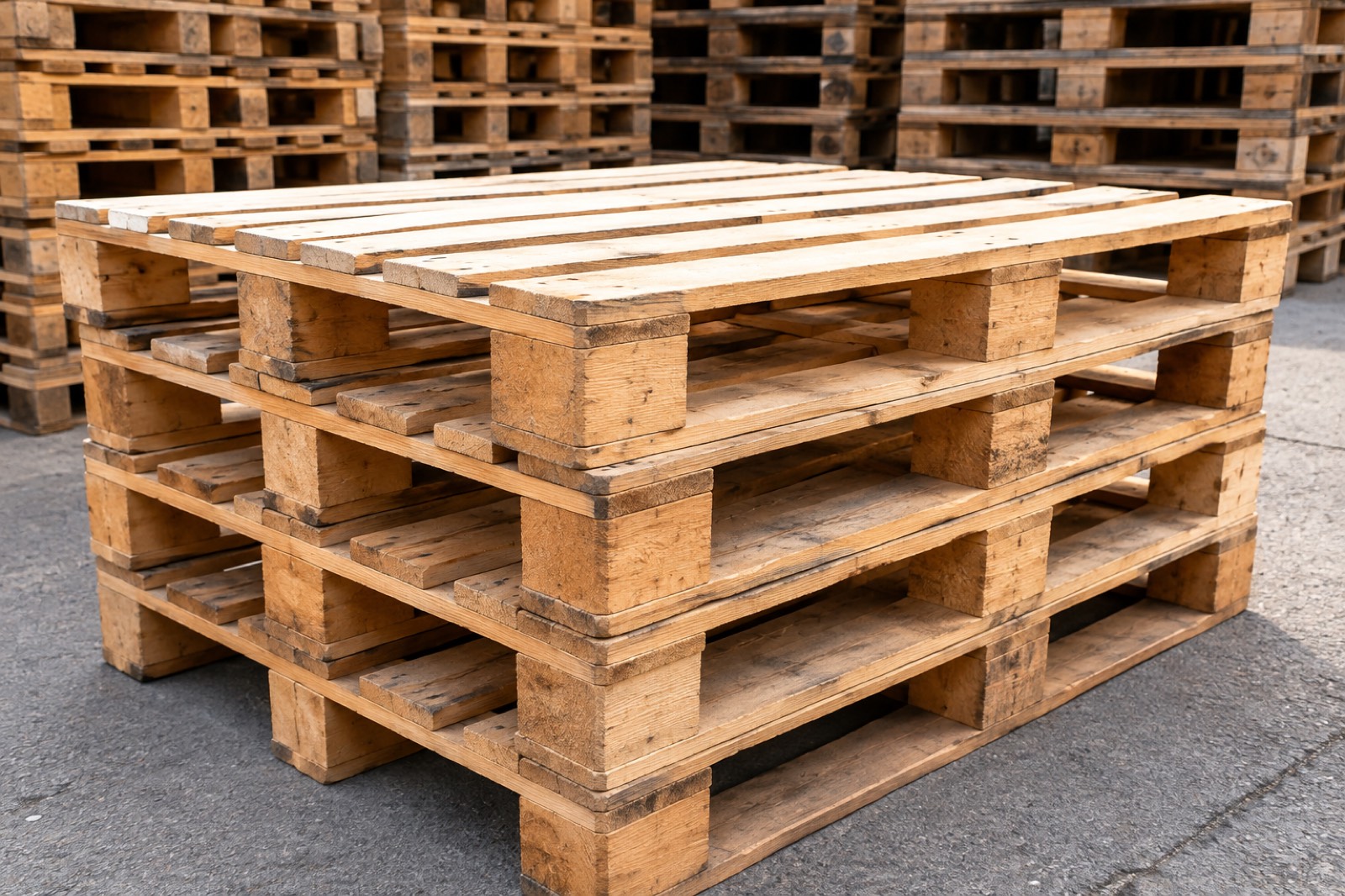
- Grades
- A, #1, #2, core
- Stock footprint
- 48 × 40 in GMA
- Availability
- Same / next day
- Carbon vs new
- ≈ 92% lower
Quote request
Price recycled stock
Quantity, footprint and grade get you a number the same day. Add your dock hours in the message and we'll propose a delivery window with it.
Why reclaimed first
The counter-intuitive truth about used hardwood
Buyers assume new is stronger. For hardwood pallets that is often wrong, and here is the reason.
New hardwood pallets are built from boards with a moisture content that can still be well into the twenties. As that wood dries in your warehouse it shrinks, nails loosen and joints lose grip — which is why a brand-new pallet sometimes squeaks and racks after a month of service.
A recycled deck has already finished that process. It has been through loading, racking, a trailer or six, and the boards that could not cope have been identified and replaced with salvaged stock of the same age. What you receive is seasoned, stable material whose failure points are known.
What a grading pass actually checks
- Stringers — no cracks through a nail line, no breaks longer than a board width, no soft rot.
- Deck boards — count, width, thickness and fastening; lead boards get extra scrutiny.
- Fasteners — protruding or missing nails pulled and replaced, never hammered flat.
- Moisture and contamination — wet, mouldy, painted or chemically stained decks are pulled from the reuse stream entirely.
- Squareness — a pallet that does not sit flat will not stack, whatever its board count.
Anything that fails goes to the repair bench rather than the bin, and anything that fails there goes to the build shop or the grinder. See grade definitions for the exact thresholds.
| Attribute | Specification |
|---|---|
| Footprint | 48 × 40 in (1219 × 1016 mm) |
| Construction | Stringer, two-way or partial four-way |
| Top deck boards | 5–7 depending on grade |
| Bottom deck boards | 3–5 |
| Board thickness | ⅝ in nominal |
| Species | Mixed hardwood, predominantly oak |
| Mass | 33–42 lb |
| Static load | 3,200–4,600 lb by grade |
| Moisture at dispatch | ≤ 19% from covered storage |
Volume & pricing bands
- 100–499Standard yard price, metro delivery
- 500–2,000Trailer-load pricing, scheduled delivery
- 2,000+ monthlyContract rate with grade split agreed
- Mixed gradesPriced per lane, no blended fudge
Prices move with the regional core market. We quote firm for fourteen days.
In numbers
What the recycled line produces
- 11,400
- graded pallets in stock todayAcross four grade lanes
- 94%
- of intake leaves as a palletReuse or repair, not fiber
- 3,000
- decks repaired weeklyAt the bench, with salvaged boards
- ≤19%
- moisture at dispatchThanks to covered storage
Buyer questions
What people ask before their first load
Lane by lane
What actually arrives when you order each grade
Four lanes leave this yard. The differences are specific, nameable and written into every contract we sign.
- 11,400
- Graded & ready today
- 72%
- Of intake is 48×40
- 6–7
- Top boards, #1 grade
- ≤19%
- Moisture at dispatch
- 33 lb
- Lightest recycled deck
- 20
- Free sample pallets
Lane detail
| Lane | Appearance | Repairs | Typical availability | Sold for |
|---|---|---|---|---|
| A / Premium | Even colour, no plugs, clean deck | None visible | 1,200–2,000 in stock | Retail-facing, audited loads |
| #1 Grade | Lightly weathered, consistent | Full-length companions | 6,000–8,000 in stock | Returning pools, racked storage |
| #2 Grade | Honest wear, mixed widths | Plugs and companions | 2,000–3,500 in stock | One-way, internal, floor-stacked |
| Core / mixed | As arrived, unsorted | None — you sort | By the trailer | Buyers who repair themselves |
What every dispatched deck has passed
- Stringers checked for cracks through a nail line
- Board count confirmed against the lane standard
- Protruding fasteners pulled and replaced, never hammered
- Squareness checked on a jig — no rocking decks
- Moisture spot-checked, covered storage only
- Chemical residue, paint and mould rejected outright
Ordering
- Metro delivery minimum
- 100 pallets
- Collection from the yard
- No minimum
- Lead time, stock grades
- Same / next business day
- Reserved stock
- Up to 8 weeks
- Quote firm for
- 14 days
- Grade dispute
- Same-day re-grade, replace or credit
Yard reference
Every number we publish, in one place
The same appendix appears at the foot of our reference pages so you never have to leave an article to check a figure. All of it is revised annually and matches the constants used by the Carbon Ledger.
Order terms
- Metro delivery minimum
- 100 pallets
- Pickup minimum (selling to us)
- 50 pallets
- Drop-off minimum
- None, during yard hours
- Out-of-region freight
- Full trailer
- Quote validity
- 14 days
- Standing-order pricing
- Fixed for the quarter
- First order terms
- Prepaid or card
- Account terms
- Net 30, approved
- Buy-back payment
- Cheque or ACH, 10 business days
- Sample before contract
- 20 pallets, free
- Grade dispute remedy
- Same-day re-grade, replace or credit
- Reserved stock
- Up to 8 weeks against a confirmed order
Standing-order customers get fixed quarterly pricing.
The yard, in facts
- Address
- 9869 Meeks Blvd, St. Louis, MO 63132
- Founded
- 2009
- Zero landfill since
- March 2017
- Grading lanes
- Four, plus new and heat-treated
- Named defects on the wall
- Thirteen
- Covered storage
- Two roofed bays
- Dock doors
- Four at 48 in, plus drive-on
- Weighbridge
- On site, certified
- Trailers owned
- Nine, plus two flatbeds
- Trailer staging spaces
- Twelve
- Pallets handled last year
- 412,000
- Hardwood kept in circulation
- 4,780 tons
- Decks repaired weekly
- ≈ 3,000
- Intake leaving as pallets
- 94%
- Mean further lives per deck
- 4.7
Counted at the weighbridge and the grading line.
Grades, side by side
| Grade | Top / bottom boards | Repairs allowed | Static | Dynamic | Racked | Price index |
|---|---|---|---|---|---|---|
| A / Premium | 7 / 5 | None visible | 4,600 lb | 2,800 lb | 1,800 lb | 42–52 |
| #1 Grade | 6–7 / 4–5 | Full-length companions | 4,000 lb | 2,500 lb | 1,500 lb | 30–40 |
| #2 Grade | 5–6 / 3–4 | Plugs and companions | 3,200 lb | 1,800 lb | Not advised | 20–28 |
| Core / Mixed | As arrived | Unsorted | Unrated | Unrated | No | 12–20 |
| New hardwood | 7 / 5 | n/a | 5,000+ lb | 3,000 lb | 2,200 lb | 100 |
| Heat-treated #1 | 6–7 / 4–5 | Companions, re-treated | 4,000 lb | 2,500 lb | 1,500 lb | 38–48 |
Footprints we stock or build
| Footprint | Metric | Known as | Typical use |
|---|---|---|---|
| 48" × 40" | 1219 × 1016 mm | GMA / grocery standard | General distribution, grocery |
| 42" × 42" | 1067 × 1067 mm | Square 42 | Drums, paint, telecom |
| 48" × 48" | 1219 × 1219 mm | Drum pallet | 55-gallon drums |
| 40" × 48" | 1016 × 1219 mm | Rotated GMA | Military, construction |
| 48" × 42" | 1219 × 1067 mm | Chemical / produce | Chemicals, produce |
| 40" × 40" | 1016 × 1016 mm | Dairy square | Dairy, beverage |
| 36" × 36" | 914 × 914 mm | Beverage | DSD, retail display |
| 48" × 20" | 1219 × 508 mm | Retail half | Aisle-end displays |
| 1200 × 800 mm | 47.2" × 31.5" | EUR / EPAL 1 | European export |
| 1200 × 1000 mm | 47.2" × 39.4" | ISO / EPAL 2 | ISO export lanes |
Per-layer fit
| Equipment | Interior width | Pattern | Per layer |
|---|---|---|---|
| 53 ft dry van | 100–102" | 48×40 straight | 26 pallets |
| 53 ft dry van | 100–102" | 48×40 pinwheel | 28 pallets |
| 48 ft dry van | 98–100" | 48×40 straight | 24 pallets |
| 20 ft container | 92.5" | 1200×800 EUR | 11 pallets |
| 40 ft container | 92.5" | 1200×800 EUR | 24 pallets |
| 40 ft HC container | 92.5" | 1200×1000 ISO | 20 pallets |
Carbon model constants
| Factor | Value | Basis |
|---|---|---|
| New hardwood pallet, embodied | 12.6 kg CO₂e | Cradle-to-gate, regional oak |
| Recycled deck, processed | 1.0 kg CO₂e | Repair, handling, yard energy |
| Net credit per reuse cycle | 11.6 kg CO₂e | Difference of the two above |
| Heat treatment, per deck | 0.9 kg CO₂e | Our chamber, measured |
| Average pallet mass | 15 kg / 33 lb | 12-month weighted mean |
| Road freight | 0.11 kg CO₂e / ton-mile | Own fleet fuel records |
| Landfill volume, broken deck | 0.12 yd³ | Uncompacted, measured |
| Mature tree sequestration | 21.8 kg CO₂e / yr | Illustration only |
| Break-even haul distance | ≈ 950 miles | Beyond this, reuse credit is cancelled |
ISPM-15 heat treatment
- Core temperature
- 56 °C minimum
- Hold time
- 30 continuous minutes
- Probe points
- Three per batch, deepest board
- Batch capacity
- ≈ 420 pallets
- Mark elements
- IPPC symbol, country, facility, HT
- Marks required on
- Two opposite sides, legible
- Bark
- Prohibited on every component
- Records retained
- 24 months
- Invalidated by
- Repair with untreated wood
- Dunnage & bracing
- In scope — must also be treated
Batch logs retained 24 months. A treated pallet repaired with untreated wood must be re-treated and re-marked.
Service rings from Meeks Blvd
| Ring | Distance | Example markets | Delivery window | Pickup window |
|---|---|---|---|---|
| One | 0–60 mi | St. Louis, St. Charles, Metro East | Next business day | 48 business hours |
| Two | 60–180 mi | Columbia, Springfield IL, Cape Girardeau | 2–4 business days | Within the week |
| Three | 180–300 mi | Kansas City, Memphis, Indianapolis | Weekly scheduled run | By arrangement |
| Beyond | 300+ mi | Quoted case by case | By arrangement | Full trailers only |
Species in our intake, and how they behave
| Species | Group | Density (lb/ft³) | Janka hardness | Behaviour in a pallet |
|---|---|---|---|---|
| White oak | Hardwood | 47 | 1,350 lbf | Our backbone: holds fasteners superbly, heavy, very durable |
| Red oak | Hardwood | 44 | 1,290 lbf | Slightly more porous than white; excellent deck boards |
| Hickory | Hardwood | 51 | 1,820 lbf | Hardest of our intake; superb stringers, splits if nailed dry |
| Maple | Hardwood | 44 | 1,450 lbf | Clean, pale, dimensionally stable; good for upcycled tops |
| Ash | Hardwood | 41 | 1,320 lbf | Tough and flexible; forgiving under impact |
| Poplar | Hardwood | 29 | 540 lbf | Light hardwood, weaker fastener grip, fine for one-way |
| Southern yellow pine | Softwood | 35 | 690 lbf | Common in new softwood builds; resinous, holds nails well |
| Spruce / fir | Softwood | 27 | 510 lbf | Lightest option; loosens soonest under repeated handling |
Moisture targets by application
| Application | Target moisture | Why |
|---|---|---|
| Food distribution | ≤ 19% | Mould risk, not strength; covered storage mandatory |
| Pharmaceutical / clean areas | ≤ 15% | Documented dryness, often new material |
| General warehouse and racking | ≤ 19% | Fastener grip and creep resistance |
| Cold chain | ≤ 15% at dispatch | Condensation cycling through the dew point |
| Export, heat-treated | ≤ 19% | Post-chamber typical; bark-free is the hard rule |
| Upcycled furniture stock | 8–12% | Conditioned indoors two weeks before machining |
| Field and agricultural use | No target | Weather governs; buy #2 and expect it |
Fasteners — two percent of the cost, most of the service life
| Fastener | Length | Shank | Withdrawal resistance | Where we use it |
|---|---|---|---|---|
| Helical-thread nail | 2½" | Twisted, thread-cutting | High, survives moisture cycling | Standard on every new build and repair |
| Annular-ring nail | 2¼"–2½" | Barbed rings | Highest | Lead boards and heavy racked specifications |
| Smooth-shank nail | 2"–2½" | Plain | Low, drops as wood dries | Not used — the reason old pallets loosen |
| Screw-shank nail | 2½" | Coarse helix | High | Block pallets and thick stringers |
| Staple | 1¾" | Crown wire | Low in hardwood | Not used here; acceptable in softwood one-way pallets |
Standards that actually govern a pallet
| Standard | Issued by | Covers | Why it matters to you |
|---|---|---|---|
| ISPM-15 | IPPC / FAO | Phytosanitary treatment of wood packaging | Mandatory for export; 56 °C core for 30 minutes, marked |
| ISO 6780 | ISO | Principal pallet footprints | Defines the six international sizes, including 1200×800 |
| ISO 8611 | ISO | Pallet test methods and performance | The basis of static, dynamic and racked load figures |
| ASTM D1185 | ASTM | Test methods for pallets and skids | North American equivalent test battery |
| GMA specification | Grocery Manufacturers Assoc. | 48×40 four-way notched stringer pallet | What 'GMA' means when stated properly |
| EPAL / UIC 435 | EPAL | Licensed European block pallet | Exchange-pool eligibility, marks and licensed repair |
| MH1 | ANSI / MHI | Pallet terminology and dimensions | The vocabulary used on our build sheets |
| NWPCA uniform standard | NWPCA | Recycled pallet grading practice | The nearest thing the recycled market has to a rulebook |
Handling and rack dimensions
| Dimension | Typical value | Note |
|---|---|---|
| Fork length | 42"–48" | Must not protrude beyond the far side of a 48" pallet |
| Fork width | 4"–6" | Wider forks spread load across deck boards |
| Fork thickness | 1½"–2" | Determines minimum pallet entry height |
| Fork spread, GMA entry | 24"–27" centres | Between the stringers of a three-stringer pallet |
| Pallet-jack wheel path | 6½" clear | Why notched stringers do not admit jacks |
| Minimum entry height | 3½" | A crushed bottom deck blocks the forks entirely |
| Rack beam span, two pallets | ≥ 96" clear | For two 48×40 pallets, 40" face out |
| Flue space, back to back | ≥ 6" | Most fire codes; check your jurisdiction |
The life of one deck, stage by stage
| Stage | Typical duration | What happens | Carbon position |
|---|---|---|---|
| Timber to pallet | Weeks | Sawn, nailed, often shipped wet | 12.6 kg CO₂e embodied |
| First life | 2–4 years | Hardest service; lead board usually fails | Credit begins at reuse |
| First repair | 2 minutes | Lead board replaced with salvaged stock | +1.8 further lives on average |
| Second to fifth life | 6–12 years | Grading, companions, re-nailing, re-grading | 11.6 kg CO₂e avoided per cycle |
| Structural retirement | — | Stringers rotted or deck beyond rebuild | Stored carbon still retained |
| Repurposed | Decades | Collars, crates, table tops, cladding | Carbon stays in the material |
| Fiber | 1–3 years | Mulch or bedding, then soil | Released slowly |
| Thermal | Immediate | Boiler-grade chip | Released at once — last resort |
Total cost of a pallet programme, indexed
| Cost line | Spot buying | Managed programme | Comment |
|---|---|---|---|
| Pallet purchase price | Index 100 | 78–86 | Grade matched to the job, not to panic |
| Emergency purchases | 6–11% of spend | ≈ 0% | Reserved stock removes the Friday scramble |
| Disposal and haulage | Index 100 | 0–20 | Cores are bought, not binned |
| Internal labour on wood | Index 100 | 45–60 | Sorting at source, scheduled collection |
| Product damage from pallets | Index 100 | 60–80 | Fewer failures from under-specified decks |
| Admin and reconciliation | Index 100 | 30 | One netted invoice a month |
| Reporting effort | Index 100 | 10 | Diversion and CO₂e arrive automatically |
| Net first-year change | — | −18% to −34% | Observed across our managed accounts |
End-of-line fiber products
| Fiber product | Screen size | Made from | Sold to |
|---|---|---|---|
| Landscape mulch, coarse | 1"–2" | Ground hardwood pallet stock | Landscapers, garden centres |
| Landscape mulch, fine | ⅜"–1" | Screened second pass | Retail bagging, municipal beds |
| Animal bedding | ⅛"–⅜" | Fine screen, metal-free | Livestock and poultry operations |
| Boiler-grade chip | Mixed | Material failing every screen above | Industrial thermal users |
| Recovered steel | n/a | Magnetically separated fasteners | Local scrap processor |
Conversions we use daily
| From | To | Multiply by |
|---|---|---|
| Inches | Millimetres | 25.4 exactly |
| Pounds | Kilograms | 0.4536 |
| Short tons | Metric tonnes | 0.9072 |
| Cubic yards | Cubic metres | 0.7646 |
| Ton-miles | Tonne-kilometres | 1.4594 |
| °F to °C | — | (°F − 32) × 5⁄9 |
| Board feet | Cubic metres | 0.00236 |
| lb/ft³ | kg/m³ | 16.018 |
The thirteen named defects on our grading wall
- 01Cracked stringer through a nail line
- 02Stringer break longer than one board width
- 03Soft rot or fungal staining
- 04Missing deck board
- 05Split lead board
- 06Plug or scab repair
- 07Protruding or missing fastener
- 08Board thinner than specification
- 09Mixed board widths on one deck
- 10Pallet will not sit flat on a jig
- 11Visible chemical residue or paint
- 12Moisture above threshold
- 13Bark present on any component
A pallet is only downgraded for a defect a grader can name out loud. If it is not on this list, it is not a reason to move a pallet between lanes.
Glossary — thirty terms worth knowing
- Core
- A used pallet bought for grading — the currency of the industry.
- Deck board
- Any board on the top or bottom face of a pallet.
- Lead board
- The outermost deck board at each end; absorbs every fork entry.
- Stringer
- The long member running the length of a stringer pallet; usually three.
- Stringer board
- On a block pallet, the board that ties the blocks together.
- Block
- One of the nine supports in a block pallet.
- Notch
- The cut-out in a stringer that creates four-way fork access.
- Chamfer
- A bevel on a lead board's lower edge to ease fork entry.
- Companion
- A full-length board nailed alongside a damaged stringer. A strong repair.
- Plug / scab
- A short piece fixed over a break. A weaker repair; #2 grade here.
- Re-nail
- Restoring the fastener pattern on a loose but intact pallet.
- Regrade
- Moving a pallet between grade lanes after inspection.
- Down-cut
- Re-cutting a larger deck into a smaller footprint.
- Static load
- Capacity at rest on a flat, continuous surface.
- Dynamic load
- Capacity while being lifted and moved.
- Racked load
- Capacity spanning beams with no deck support. Always the smallest figure.
- Unit load
- Pallet, product and wrap considered as one structure.
- Overhang
- Load or deck projecting beyond its support. The leading cause of rack failure.
- Flue space
- The gap between back-to-back rack bays; six inches minimum in most codes.
- GMA
- The Grocery Manufacturers Association 48×40 specification.
- EPAL
- The licensing body for the European 1200×800 block pallet.
- ISPM-15
- The international phytosanitary standard for wood packaging.
- HT
- Heat treatment: 56 °C at core for 30 minutes.
- IPPC mark
- The wheat-sheaf stamp evidencing phytosanitary treatment.
- Collar
- Four hinged timber sides that turn a pallet into a container.
- Top cap
- A lightweight cover protecting the uppermost layer of a stack.
- Dunnage
- Timber used to fill voids, brace loads and spread point loads.
- Fiber
- Ground wood: mulch, animal bedding or boiler-grade chip.
- Diversion rate
- Share of intake kept out of landfill. Ours is 100%.
- Reuse rate
- Share of intake that leaves as a pallet. Ours is 94%.
Still wondering?
Eight questions that arrive most weeks. The full set lives on the FAQ page, and anything missing can go straight into the form at the top of this page.
Asked most weeks
Next step
Stock is standing in the yard right now
Tell us the footprint, grade and count. If it's in the covered bay, it can be on a trailer tomorrow morning.
Quote request
Let's price your pallets
The same desk, the same people, whatever page you came from. Give us the volume and the grade and we'll come back with availability, price and the next trailer out.
Yard9869 Meeks Blvd, St. Louis, MO 63132
HoursMon–Thu 7:00–5:00 · Fri 7:00–3:30 · Sat 8:00–12:00 CT